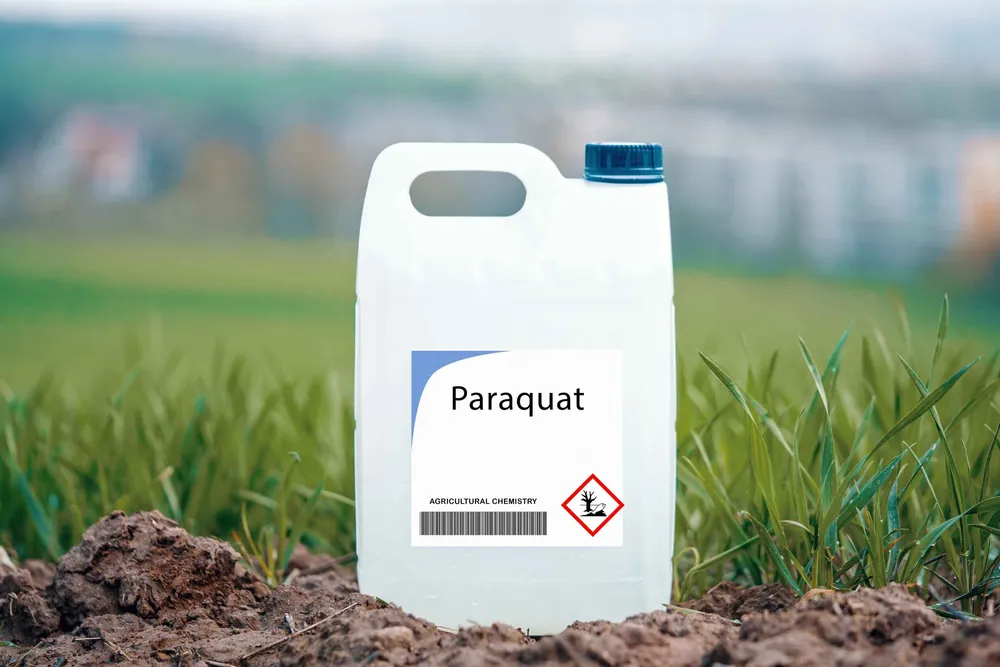
Paraquat is one of the most acutely toxic herbicides still in commercial use — so hazardous that the EPA restricts it to licensed applicators and more than 50 countries have banned it outright. Sold in the United States since 1966 under brand names including Gramoxone, Firestorm, Helmquat, and Parazone, it was sprayed across corn, soybean, cotton, and orchard acreage for decades. The people who handled it — farmers, commercial applicators, farmworkers, and landscapers — mixed and loaded the concentrate and sprayed it from backpack units, handguns, and tractor rigs, season after season, absorbing it through the skin, inhaling drift, and wearing splashes of it on their clothes.
Peer-reviewed research has since linked chronic paraquat exposure to Parkinson's disease, a progressive and incurable neurological disorder; one widely cited study found exposed individuals faced a 1.3 to 3.6 times greater risk. Plaintiffs allege Syngenta and Chevron understood that risk for years and failed to warn the people spraying it. More than 6,600 claims are now consolidated before Chief Judge Nancy J. Rosenstengel in MDL 3004 in the U.S. District Court for the Southern District of Illinois, with additional cases in state courts including Philadelphia. A settlement framework has been under negotiation since 2025 but is not yet final, and attorneys continue to review new claims.
If you mixed, loaded, or sprayed paraquat — or worked and lived around the fields where it was applied — and were later diagnosed with Parkinson's disease, you may be able to bring a claim.

Every detail you share through this case review — your work and exposure history, the farms or job sites where you handled paraquat, your diagnosis and medical records, and how Parkinson's has affected you — stays between you and our intake team. We do not sell, rent, or share your information with third parties, and your participation is never made public.
Damages vary by case, and every claimant's exposure history and diagnosis is different. Common categories of damages in paraquat Parkinson's cases include:
Neurologist and movement-disorder specialist care, diagnostic imaging and testing, prescription medication such as levodopa-carbidopa, and physical, occupational, and speech therapy — treatment that manages the symptoms of a disease that currently has no cure.
Parkinson's is progressive. Later-stage costs can include deep brain stimulation surgery, mobility equipment, home modifications, in-home caregiving, and eventually assisted living or skilled nursing care.
Wages lost as tremor, rigidity, and slowed movement make farm, applicator, and equipment work impossible, the early retirement a diagnosis often forces, and the lasting reduction in earning capacity that follows.
Tremor, stiffness, difficulty walking and swallowing, loss of speech, and the cognitive decline and diminished quality of life caused by a progressive, incurable neurological disease.
Damages available to a spouse or family for the companionship, support, and shared life lost as Parkinson's advances and caregiving takes the place of the relationship you had.
For families who lost a loved one to complications of Parkinson's disease: funeral and burial expenses, loss of future financial support, and loss of society and companionship.
Claims are brought against Syngenta and Chevron — the companies that manufactured and distributed paraquat in the United States — on theories including negligence, design defect, failure to warn of the Parkinson's risk, and concealment of what the companies knew about the chemical's neurotoxicity. Where the conduct is found especially egregious, punitive damages may also be available. Filing deadlines are set by each state's statute of limitations and often run from the date of diagnosis, so the time available to bring a claim may be limited.
See if You QualifyAt Shenaq PC, we represent farmers, licensed applicators, agricultural workers, and their families in claims against the manufacturers of paraquat. Our attorneys work closely with each client to reconstruct the exposure history a case depends on, and to pursue accountability from the companies that kept selling a chemical they had reason to know was dangerous.
Our attorneys handle complex product-liability and toxic-tort cases against chemical manufacturers — litigation that turns on reconstructing exposure history, proving medical causation, and uncovering what a company knew and when. The team reviewing your case has worked in this category before.
We come ready to take cases through to trial when defendants resist a fair resolution. The credible threat of trial is what drives settlements — and it's a posture not every firm can credibly hold.
You pay nothing up front and nothing during the case. Fees only apply if we recover compensation on your behalf.
This is an advertisement of the law firm Shenaq PC, located at 3500 Lenox Road, Suite 1500, Atlanta, GA 30326, to bring claims against public and private institutions and, in appropriate cases, individuals in the United States. This webpage’s content is provided for informational purposes only by Shenaq PC. This site contains general information that may not be up to date, assumes findings of fact, and is for illustrative purposes only. A more detailed analysis of your particular case would be required to obtain a better evaluation of your potential claim. There is no guarantee that a Court or Arbitrator would rule in your favor. This does not create a client-attorney relationship. It is not intended to provide legal advice. For legal advice, you will need to consult an attorney at Shenaq PC. Past results are not indicative of future results and do not guarantee any particular outcome.